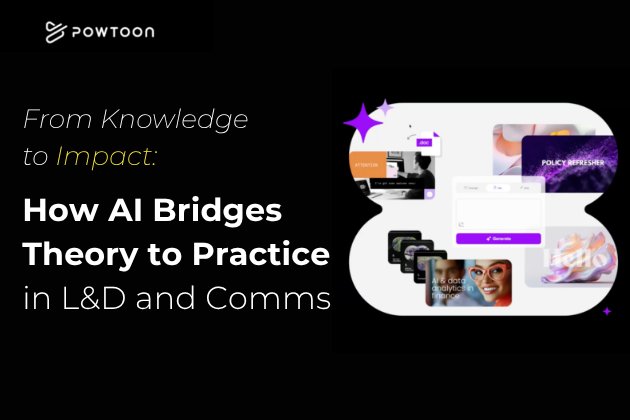
How AI Bridges Theory to Practice in Learning, Development and Communications
Organizations often rely on established frameworks — such as ADDIE (Analyze, Design, Develop, Implement, Evaluate) and ADKAR® (Awareness, Desire, Knowledge, Ability, Reinforcement) — to guide learning and change efforts. These frameworks help teams understand what to do. The bigger challenge is turning that knowledge into action that drives measurable impact.
AI helps bridge this gap by enabling teams to generate relevant, structured content at scale, and by streamlining execution workflows so strategy becomes practice. Platforms like Powtoon and Powtoon Learnflow help organizations turn strategic insight into engaging visual and learning experiences, aligning theory with real-world impact.
1. Understanding the Strategic-Operational Alignment: ADKAR® Meets ADDIE
Before we address the execution gap, let’s establish why these frameworks matter – and how they work in tandem.
ADKAR®: The Individual Change Journey
Prosci’s ADKAR® model maps the psychological stages individuals move through during organizational change:
- Awareness of the need for change
- Desire to participate and support the change
- Knowledge of how to change
- Ability to implement required skills and behaviors
- Reinforcement to sustain the change
ADKAR® tells us where people are in their journey and what they need at each stage. It’s diagnostic and prescriptive for change management.
ADDIE: The Instructional Design Framework
The ADDIE model (Analysis, Design, Development, Implementation, Evaluation) provides the operational structure for creating learning experiences that move people through that journey:
- Analyze the change requirements and audience needs
- Design learning objectives and content strategy aligned to ADKAR® stages
- Develop the actual learning materials and communications
- Implement the rollout across your organization
- Evaluate effectiveness and iterate
Why They Work Together
ADKAR® without ADDIE is strategy without execution. You understand your audience’s journey but lack the operational framework to build appropriate touchpoints.
ADDIE without ADKAR® is execution without empathy. You’re building systematic learning experiences but missing the psychological reality of how people actually change.
Together, they create both strategic clarity and operational rigor. ADKAR® informs what content you need at each stage. ADDIE provides how to build and deliver it systematically.
2. When Theory Meets Reality
Here’s the uncomfortable truth about traditional change management execution:
Strategic intent: Deploy a comprehensive ADKAR®-aligned campaign with distinct content for Awareness, Desire, Knowledge, Ability, and Reinforcement stages.
Operational reality: You have a limited budget, a three-person team, and a four-week deadline. So you compromise:
- Awareness stage gets a leadership email and maybe a town hall
- Desire, Knowledge, and Ability collapse into one 45-minute e-learning module that tries to do everything
- Reinforcement becomes a quarterly reminder email (if anyone remembers)
By the time you’ve developed comprehensive content through traditional means – weeks of vendor negotiations, scriptwriting, production, review cycles – your change window has closed. The organization has moved on. The initiative loses momentum.
As Mitch Wells noted during our event, this creates a fundamental disconnect: L&D and Communications teams know what sophisticated change management looks like. They just can’t operationally deliver it at the speed modern business demands.
3. Making Frameworks Actionable
This is where the conversation shifts from theoretical to transformational.
AI doesn’t replace frameworks – it makes them operationally feasible for the first time at enterprise scale.
The New Execution Model
What if the same source material – a policy document, a training manual, a strategic initiative brief – could automatically generate content optimized for each stage of the ADKAR® journey, following ADDIE’s systematic development principles?
ADKAR® Stage → Content Type → Purpose:
Awareness: 30-second video trailer → Grab attention, create urgency, establish “why it matters”
Desire: Emotionally engaging narrative video → Build personal connection, show benefits, create motivation
Knowledge: Comprehensive presentation-style videos and micro-learning modules → Transfer information, build understanding, ensure retention
Ability: Step-by-step demonstration videos and scenario-based training → Build skills, enable practice, create confidence
Reinforcement: Reminder snippets and success celebration videos → Prevent backsliding, recognize progress, sustain change
The transformation: What took months with traditional production now happens in under an hour. The change management strategy that existed only in PowerPoint slides becomes an executable campaign while your change window is still open.
4. From Cost Center to Strategic Driver:
This operational transformation creates strategic opportunity.
When your team can execute sophisticated, framework-aligned change campaigns at scale, the organizational conversation changes:
Old conversation:
“How much will this training cost?”
“How long until we have content?”
“Can we afford a comprehensive approach?”
New conversation:
“What’s the behavioral change we need to drive?”
“How do we measure campaign effectiveness across the journey?”
“What’s the strategic sequence for rolling this out globally?”
You’re no longer defending budget requests for content production. You’re discussing strategic impact and measurable business outcomes.
This is how L&D and Internal Communications move from tactical execution to strategic enablement. You’re not just communicating change – you’re architecting the journey that makes change stick.
5. Measurement Completes the Loop
But sophisticated content creation is only half the transformation. The other half is understanding what’s working.
Traditional ADDIE includes Evaluation, but here’s the challenge: How do you evaluate campaign effectiveness when your content is scattered across email, LMS platforms, SharePoint sites, and Slack channels?
The complete transformation requires:
Campaign Deployment: Content distributed through existing communication channels (Teams, email, intranet) with unified tracking
Stage-Specific Analytics:
- Awareness: Did the trailer get watched? Where did people drop off?
- Desire: Are engagement rates showing emotional connection?
- Knowledge: Are comprehension metrics showing information retention?
- Ability: Are practice scenarios being completed? What’s the success rate?
- Reinforcement: Is sustained engagement happening over time?
Continuous Optimization: Use data to refine messaging, adjust pacing, identify segments needing additional support, and prove ROI to leadership.
This closes the ADDIE loop – moving from theoretical evaluation to measurable, data-driven optimization of your change management strategy.
The Strategic Imperative: Change Management as Competitive Advantage
Here’s the bottom line for enterprise L&D and Communications leaders:
Organizations are being asked to change faster than ever. Digital transformation. AI adoption. Process optimization. Cultural evolution. Regulatory compliance. The pace isn’t slowing down.
The organizations that win will be those whose L&D and Internal Communications functions can execute sophisticated, framework-aligned change campaigns at the speed of business.
The organizations that struggle will be those where brilliant change management strategy remains trapped in documents and spreadsheets, unable to become operational reality before the change window closes.
The frameworks haven’t changed. ADKAR® and ADDIE remain as relevant as ever.
What’s changed is the operational capacity to execute them at enterprise scale – to move from knowing what people need at each stage of their journey to actually delivering it, measuring its effectiveness, and optimizing in real time.
What This Means for Your Function
If you’re leading L&D or Internal Communications in an enterprise organization, ask yourself:
- How long does it take your team to go from change initiative kickoff to deployed, multi-stage campaign?
- What compromises do you make between strategic ideal and operational reality?
- How do you measure the effectiveness of your change communications across the audience journey?
- What would change if you could execute comprehensive ADKAR®/ADDIE-aligned campaigns in hours instead of months?
- How would your function’s strategic positioning shift if you could prove measurable impact on behavior change at scale?
The execution gap isn’t going away through better project management or larger teams. It requires fundamentally rethinking your operational model for the AI era.
The question isn’t whether AI will transform L&D and Internal Communications. It’s whether your organization will lead that transformation or follow it.
Continue the Conversation
Want to explore how leading organizations are operationalizing change management frameworks at scale?
Watch the full Unboxing II event featuring Mitch Wells’ insights on bridging the execution gap, including a live demonstration of ADKAR® -aligned campaign creation.

Q&A: AI, Learning Frameworks and Organizational Impact
Q – Isn’t learning theory enough on its own?
No. While frameworks like ADKAR® and ADDIE provide structure, most teams lack the operational capacity to execute them at scale and speed without automation.
Q – How does AI support instructional design?
AI can generate tailored learning content from source materials, align content with strategic stages, and speed content creation so teams can focus on outcomes.
Q – Can AI replace human designers and communicators?
No. AI accelerates execution but works best when paired with human judgement on learning goals, audience needs, and quality standards.
Q – Why should L&D teams use tools like Powtoon?
Tools like Powtoon enable teams to generate, customize, and distribute content aligned to learning and communication frameworks while preserving brand, context, and learning outcomes.
Expert Insight
“AI is not a substitute for thoughtful strategy; it is a way to make strategy operational. When teams can generate framework-aligned, audience-specific content at scale, the gap between knowing what to do and actually doing it starts to disappear,” says Powtoon’s Head of Product.
Final Thought
Bridging the gap between knowledge and impact requires more than frameworks. It requires tools and workflows that can translate strategic insight into engaging, scalable content. By combining proven instructional and change models with AI-assisted content creation, organizations can move from planning documents to measurable change in real time.
Powtoon helps teams make this transition by supporting strategic alignment, rapid generation, and iterative measurement — turning theory into practice without sacrificing quality or speed.
ADKAR® is a registered trademark of Prosci, Inc. All rights reserved.
The teams positioning themselves as strategic change enablers – not tactical content producers – are the ones building sustainable influence in their organizations. Where does your function stand?

Ilya Spitalnik
Latest posts by Ilya Spitalnik (see all)
- AI avatars in branding: How to create branded video ads that stand out - September 3, 2026
- How to make an AI video tutorial - September 3, 2026
- Powtoon’s Unified AI Video Platform: A New Era for Enterprise Visual Communication - December 17, 2025
- How AI Bridges Theory to Practice in Learning, Development and Communications - October 23, 2025